
DEON is a visual collaboration platform. It offers a completely new and intuitive way of working and collaborating.
This tutorial provides you with the fundamentals you need to get started.
The DEON AI integration DEON Holistic Intelligence with the AI assistant DAIA is not covered in this tutorial. Please visit the following pages for that:
deon.de/deon-holistic-intelligence/
deon.de/dhi-10-ki-funktionen/
deon.de/help/bedienungsanleitung-daia/
A list of the new features in the current DEON version can be found at https://deon.de/help/whats-new.
You can download the app at https://account.deon.cloud/ download.
For the fastest learning success, please don't skip any step and read every NOTE and TIP.
- 1 Setup
- 2 Create your first DEON project
- 3 Create Text
- 4 Navigate
- 5 Create Screenshots
- 6 Move and scale elements
- 7 Drag files and documents into the workspace
- 8 Embed web browser
- 9 Stack elements to create groups
- 10 Crop and Resize
- 11 Multi-page Documents
- 12 Template Library
- 13 Presentation Paths
- 14 Copying between Projects
- 15 Share and Link
- 16 Export
- 17 Versioning
1 Setup
After you have installed DEON, make sure that the DEON icon is in your taskbar (usually at the bottom right of your screen): 
If you can't find it in your taskbar, you may need to drag it from the hidden icons area to there:
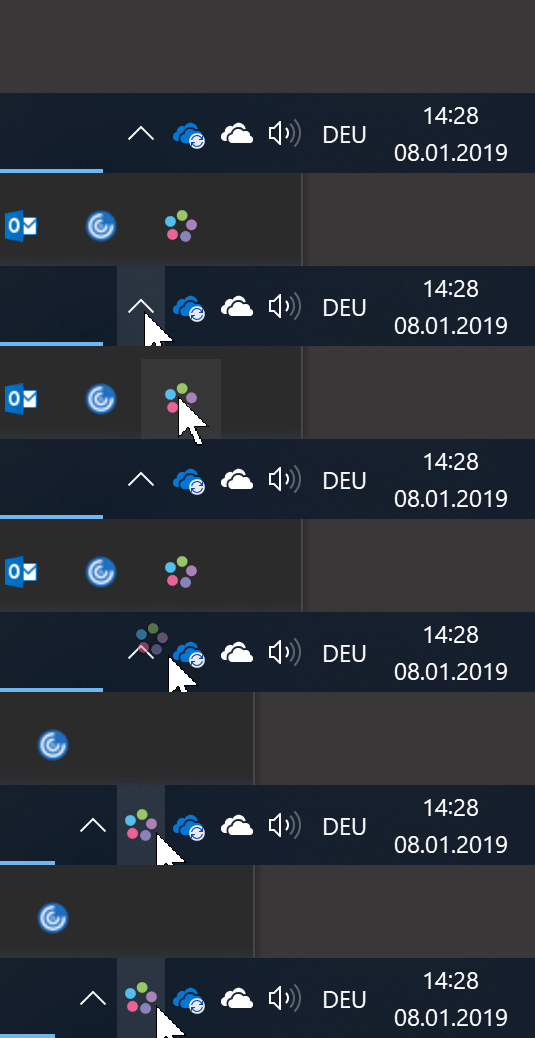
If you can't find it in the hidden icons area, start DEON once via your Windows Start menu or from your desktop.
Back to top2 Create your first DEON project
Left-click on the DEON icon in your taskbar  to display the DEON start screen.
Press  . Your first DEON project will appear:
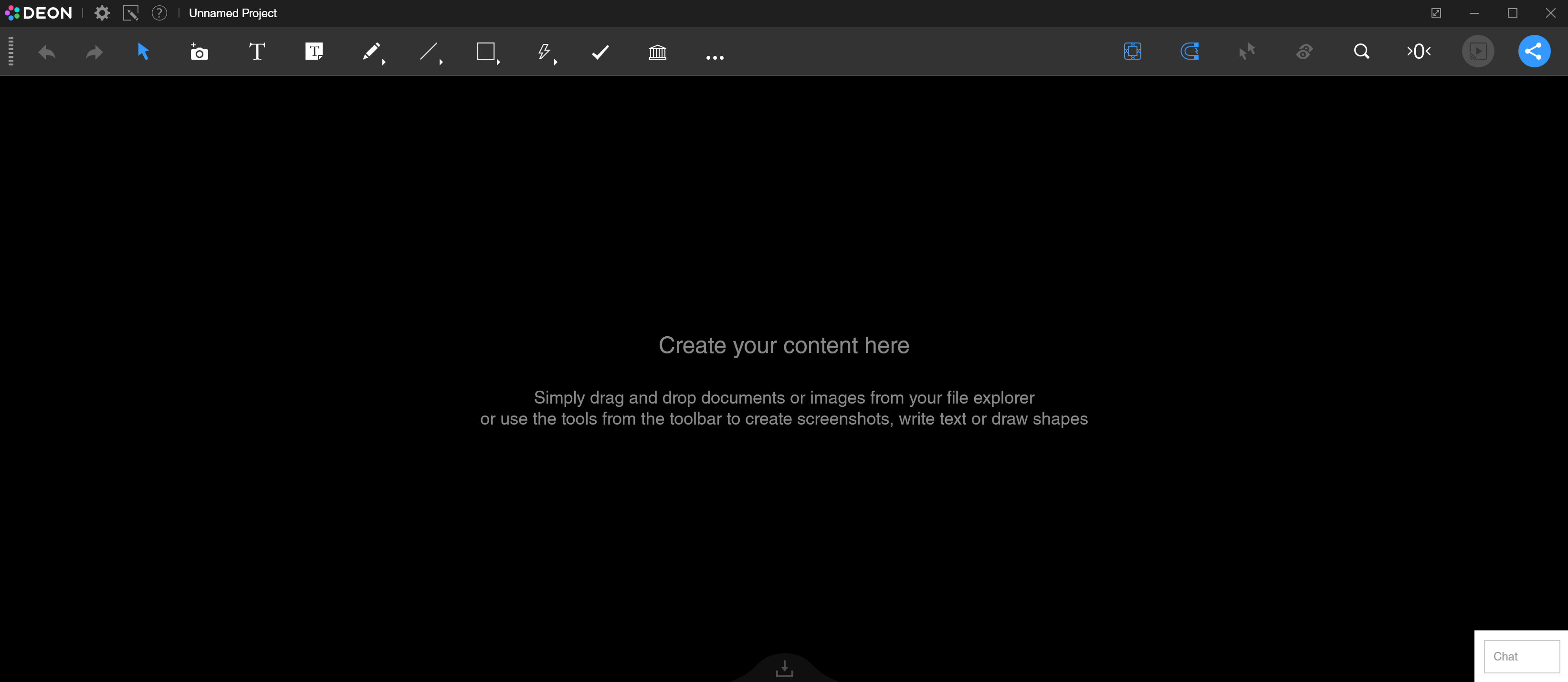
TIP You can also right-click the DEON taskbar icon and select "New Project" to be even faster.
Back to top3 Create Text
Use the  text tool or press Tab, then left-click anywhere in the workspace and start typing. To finish the text, click anywhere in the empty workspace.
Create a new text, start typing, but press Enter while holding Ctrl. This starts a new text below your current one.
Now place your text cursor somewhere in the middle of your text line and press Enter again while holding Ctrl. This splits your text into two parts.
Instead of Ctrl+Enter you can also press Tab to create the new text to the right.
TIP
You can find a complete list of keyboard shortcuts here TIP You can even create polls with text labels. Take a look here!
4 Navigate
Move: Hold down the right mouse button and move the mouse to shift your workspace. This does not move the elements (your text lines), but only your view.
Zoom: While you hold down the right mouse button, also press and hold the left mouse button. Move the mouse up or down while holding both mouse buttons to zoom. This "Powerzoom" is much better than using the mouse wheel to zoom.
NOTE The center of the zoom is always the position of your mouse.
TIP Remember these steps to navigate like a pro:
- Move your mouse to the location of your interest.
- Hold down the right mouse button and move your mouse to bring this point to the center of your screen.
- Continue holding down the right mouse button and press and hold down the left mouse button, then move your mouse down to zoom in.
TIP If you get lost in the space, press  in the toolbar to view the entire project.
TIP If you're using a laptop with a trackpad but no mouse: Place your left pinky finger on Ctrl and your left index finger on Space. Hold down both keys and move your right index finger on the trackpad to shift your view (without clicking the trackpad buttons). To zoom, keep your left pinky finger on Ctrl and simply slide your left index finger from Space to Alt. Then move your right index finger up/down on the trackpad (without clicking the trackpad buttons).
Back to top5 Create Screenshots
NOTE You can create screenshots of any application. In the following example, you will create a screenshot of a web browser. In this case, DEON automatically saves a link to the website for you.
- Open any website
- Go back to DEON and click on the
 Screenshot button in the main menu or press S. DEON automatically brings the previously active window to the foreground (in this case your web browser) and a crosshair cursor appears.
 - Drag a selection frame with the left mouse button
- Your screenshot appears in the inbox below your workspace
- Drag the screenshot from the inbox into the workspace.
NOTE DEON has automatically saved the link to the website in the screenshot. This allows you to create visual bookmarks without wasting time naming or sorting traditional bookmarks.
Select the screenshot in the workspace (left-click) and click the  link button in the top right corner. Your default web browser will open the linked URL.
TIP The automatic link also works when you create screenshots of documents like PPTX, XLSX, DOCX, or PDF.
TIP You can create a screenshot of the project itself by holding down the shift key before clicking the screenshot button.
6 Move and scale elements
Drag elements with the left mouse button to change their position in the workspace.
TIP To quickly duplicate elements, hold down Ctrl before releasing the dragged element.
Multiple Selection
To move multiple elements, first drag a multiple selection frame (left mouse button) around the elements (elements must be completely within the frame) and then drag the entire multiple selection. To cancel the multiple selection, click anywhere in the empty workspace.
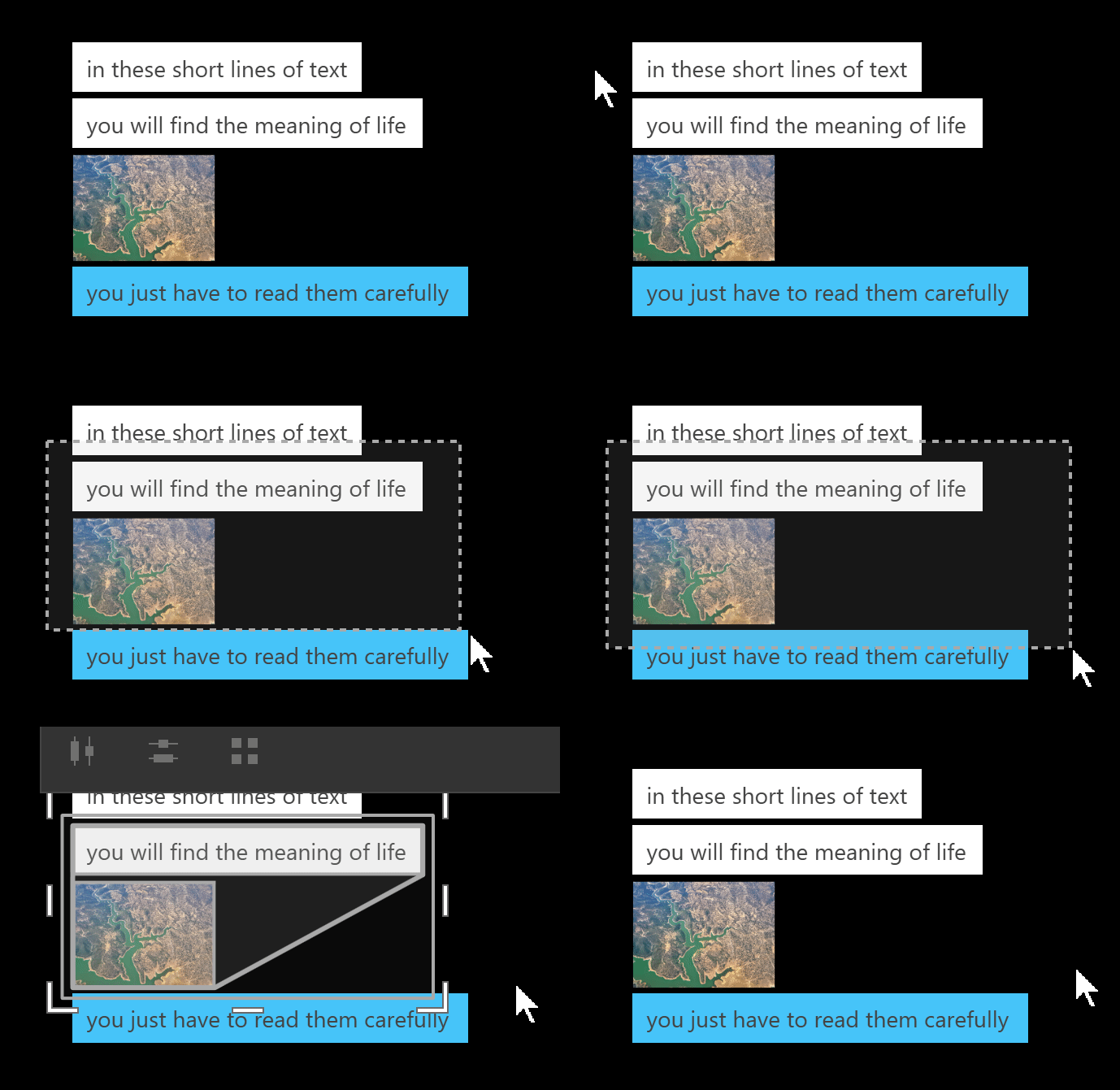
TIP By holding down Alt before starting the multiple selection, you can perform a multiple selection anywhere without accidentally moving a background element.
TIP To use a lasso, hold down Shift before starting the multiple selection. The lasso selects all elements that are touched by it or at least partially within the lasso.
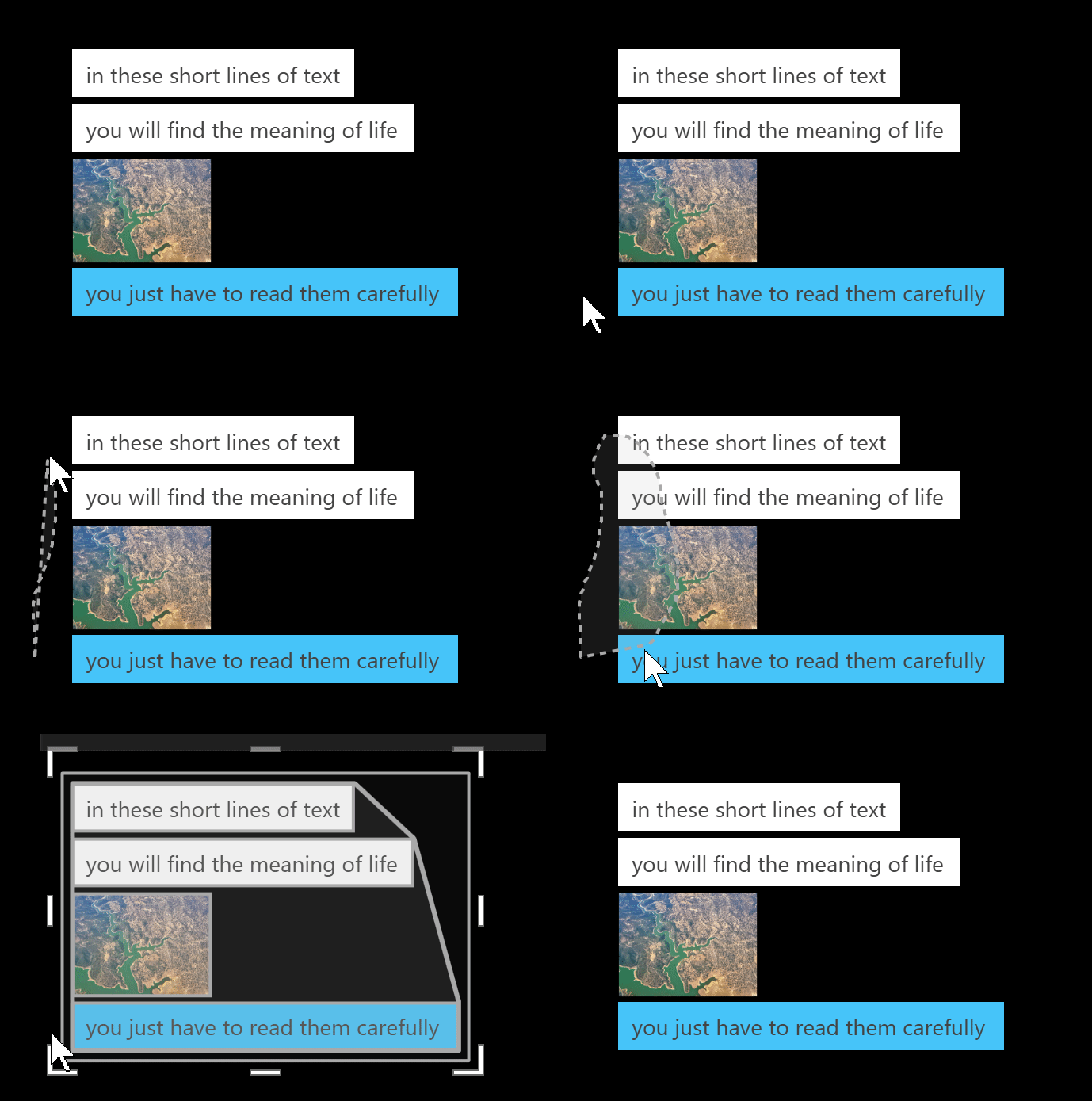
TIP Hold down Shift or Ctrl and click on the elements or drag a selection frame around the elements you want to add to or remove from an existing multiple selection.
TIP To align multiple elements: Drag a multiple selection and then use the  alignment buttons in the context menu or use the Auto Arrange function.
Scale
To scale an element or an entire multiple selection, drag one of the  scaling handles at the corners.
NOTE Scale elements only if you really want to change their size. If you want to take a closer look at something, don't scale the element, but instead zoom your workspace. If you're unsure whether an element is too big or too small, click the 'Show entire project' button  and then the 0-level button
  to zoom to 0-level. Rule of thumb: At 0-level, a document page or PowerPoint slide fits in the workspace.
Smart Align
The blue Smart Align lines help you align elements. You can disable Smart Align by shaking an element quickly or toggling the Smart Align button  .
.
Autoarrange
Use the double-line handles 
 to quickly align and rearrange elements. To evenly stretch the distances: Select all elements, push them together first, then deselect, reselect them, and stretch them outward.
7 Drag files and documents into the workspace
- Open the Windows File Explorer by clicking on the Explorer button or by pressing Win+E.
- Now select a PowerPoint document and drag it into your DEON workspace.
NOTE DEON supports many different formats, but we will need a PowerPoint later in this tutorial.
Copied vs. linked files
Drag the same PowerPoint document into your workspace again, but this time hold down (shortly before releasing) Shift.
NOTE By holding down Shift, you can choose between linking or copying a file. A linked file is not copied to the DEON server, but a link to your original file location (local drive, network share, or SharePoint/OneDrive) is created.
NOTE If your file explorer folder was a OneDrive folder, DEON automatically links to OneDrive and you can edit the file directly in the DEON workspace.
Now open your original PowerPoint document by double-clicking in your normal Windows File Explorer (not in DEON). Make some changes and close it again (save changes). Note that you will see the changes in your DEON workspace after a few seconds. The copy you first dropped (without pressing Shift), does not change because it was copied to the DEON server and has no connection to the original file. However, you can still open and edit it by selecting it and pressing the file button in the upper right corner. The linked document also has a link button in the upper left corner that takes you to its original storage location.
NOTE Benefits of linked files:
- No redundant copies.
- Keep the file accessible at its original location outside of DEON.
- See changes to documents in DEON immediately when someone modifies the original file outside of DEON.
NOTE Note when using linked files:
- If the original file is deleted outside of DEON or its storage location is unreachable, only a gray placeholder is visible in DEON.
- If you share your DEON project with other users (as described later in this tutorial), make sure they have access to the original file (e.g. in a shared network folder). Otherwise, they will only see a gray placeholder.
- If you link files from a local drive (not a network drive) on your computer, they are only visible in DEON on the same computer.
Using Excel Files
NOTE If you have Microsoft O365, you can edit Excel files directly in the DEON workspace. Otherwise, you can use the built-in DEON Excel Viewer:
- Drag an Excel file from your Windows File Explorer into the DEON workspace using Drag & Drop. If it contains multiple sheets, DEON lets you select them.
- Crop the sheets using the horizontal and vertical handles

 .
. - Scroll vertically and horizontally with the right mouse button or two fingers, or use the mouse wheel. To add sheets from the same file, select an existing sheet in the workspace and click "Add Sheet" in the context menu.
 .
.
Editing MS O365 documents directly in the workspace
NOTE
Skip this step if you don't have Microsoft O365 Select a document that you have dragged from your file explorer OneDrive folder into the DEON workspace.
For PowerPoint and Word: Click on the MS Office button in the context menu  . Select the document again, wait until the green frame appears, and start editing.
For Excel: Simply wait until the green frame appears and start editing.
TIP You can also drag and drop file folders from your Windows File Explorer into the workspace. They will appear as links. If the folder contains only images with identical dimensions, they will appear as a slideshow.
TIP DEON has a built-in file watcher called "Monitor Current Files" that can automatically display the latest file in a folder. This works with network folders and local folders. Monitoring current files is particularly useful when working with constantly updated versions of the same document in a folder. DEON automatically searches for the latest file in the folder that matches a predefined naming convention. To use Monitor Current Files, follow these steps:
1. Drag a file from a network folder or a local folder into the workspace. Make sure to hold down the Shift key before dropping the file to link it instead of creating a copy.
2. Select the file in the workspace. In the context menu, click the "Monitor Current Files" button (a folder icon with an eye in it). Check the "Enable monitoring" checkbox and enter the string to be matched with the file name. Optionally, you can also add a second string and combine it with AND or OR logic.
8 Embed web browser
The unique DEON Metabrowser Engine allows you to embed hundreds of websites and web applications into any DEON project. See and use them immediately side by side with all your other content. Whatever web-based application you use for your work, you can use it directly in DEON.
Open your preferred web browser, navigate to any website, copy the URL (like https://en.wikipedia.org) to your clipboard by selecting it and pressing Ctrl+C. Then go back to DEON and paste the URL into your workspace by pressing Ctrl+V. You can also drag and drop the URL from your web browser to DEON.
A web browser in the workspace is created. It is active (blue frame) when you select it. To deactivate it again, click somewhere outside the web browser. To keep it permanently active, click on the  "Keep Active" button in the context menu.
TIP You can use web applications like MS Office365 or Google Docs in your DEON workspace by simply pasting the URLs from your normal browser. Or drag and drop your files directly from your OneDrive Windows File Explorer folder and press the MS Office button in the context menu.
TIP YouTube and Vimeo URLs are automatically recognized and videos appear without borders.
Back to top9 Stack elements to create groups
NOTE Grouping elements in DEON is as simple as stacking paper.
Select multiple elements in your workspace and click on  in the context menu. DEON automatically creates a shape in the background of the selected elements.
You can also create such shapes manually:
Click on the  Shapes button in the main menu or press M, select a fill and outline color, and then click and drag in the workspace.
To extract elements from a stack, simply delete the background element:
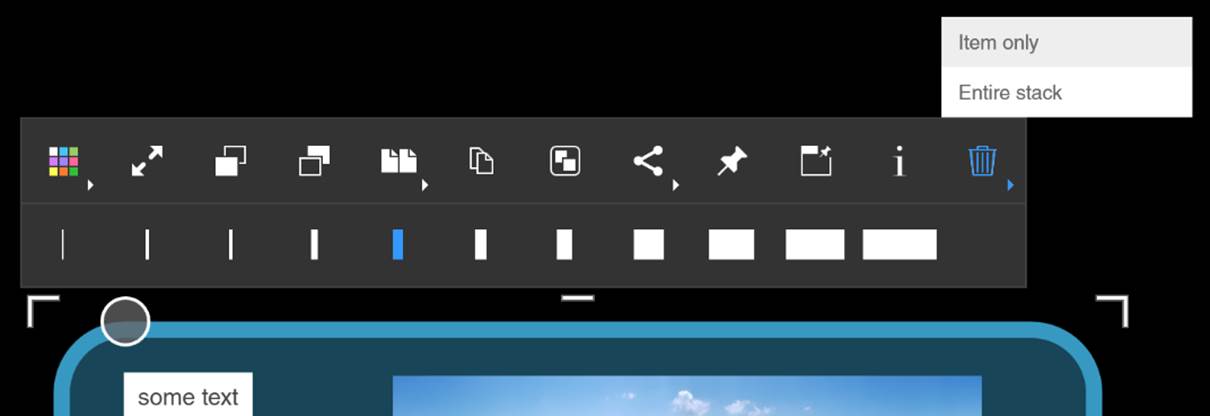
Or simply move elements away from the background. If you wait before releasing, the background shape expands automatically. To prevent this “automatic resizing”, simply release faster.
NOTE You can enable or disable this behavior in the settings under “Input and Navigation/Auto-Expand”.
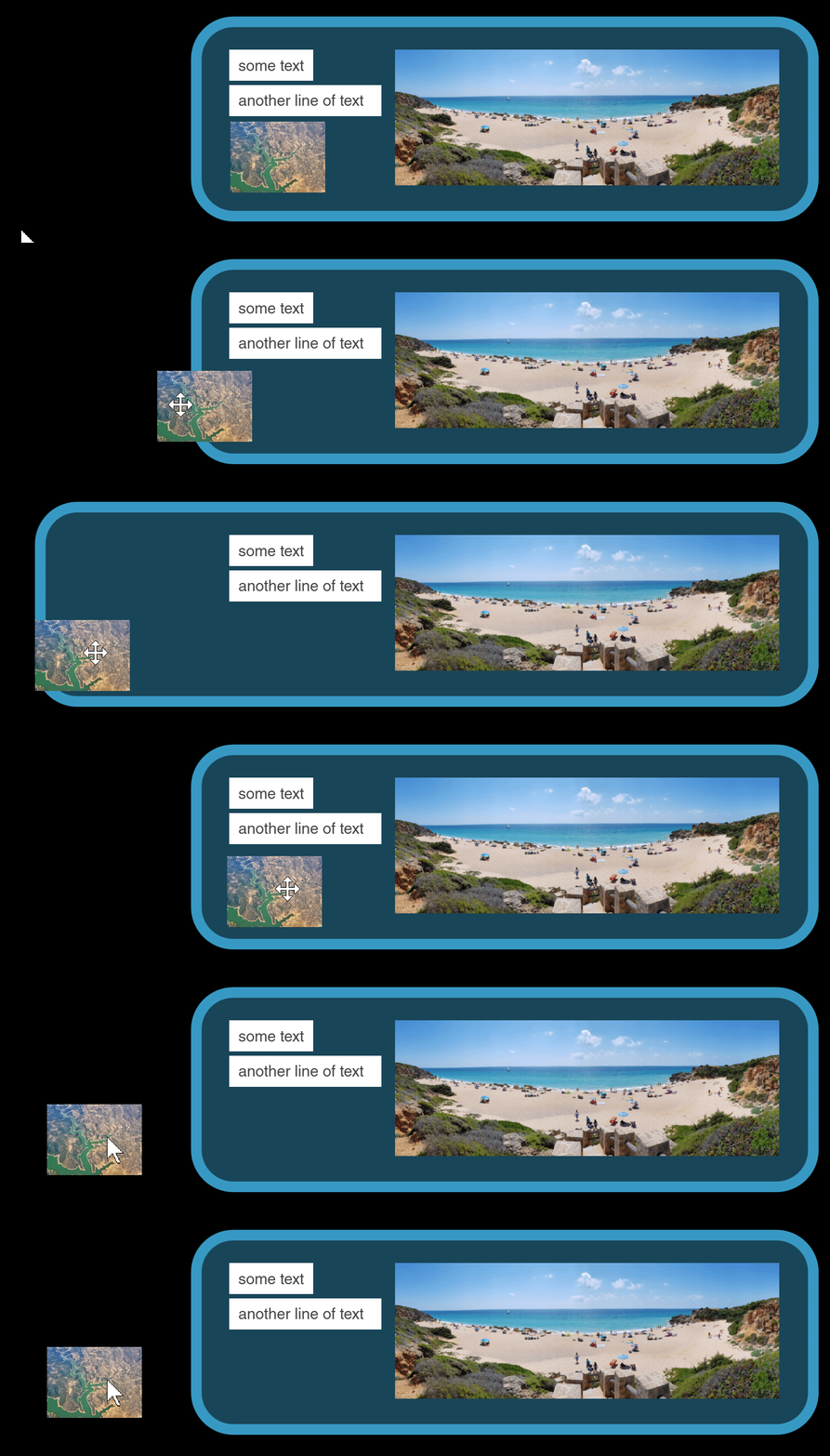
Automatic rising and docking
NOTE DEON automatically brings elements to the foreground when they are covered by larger elements:
Try it out by dragging a shape or document over other (smaller) elements in the workspace. The obscured elements rise automatically:
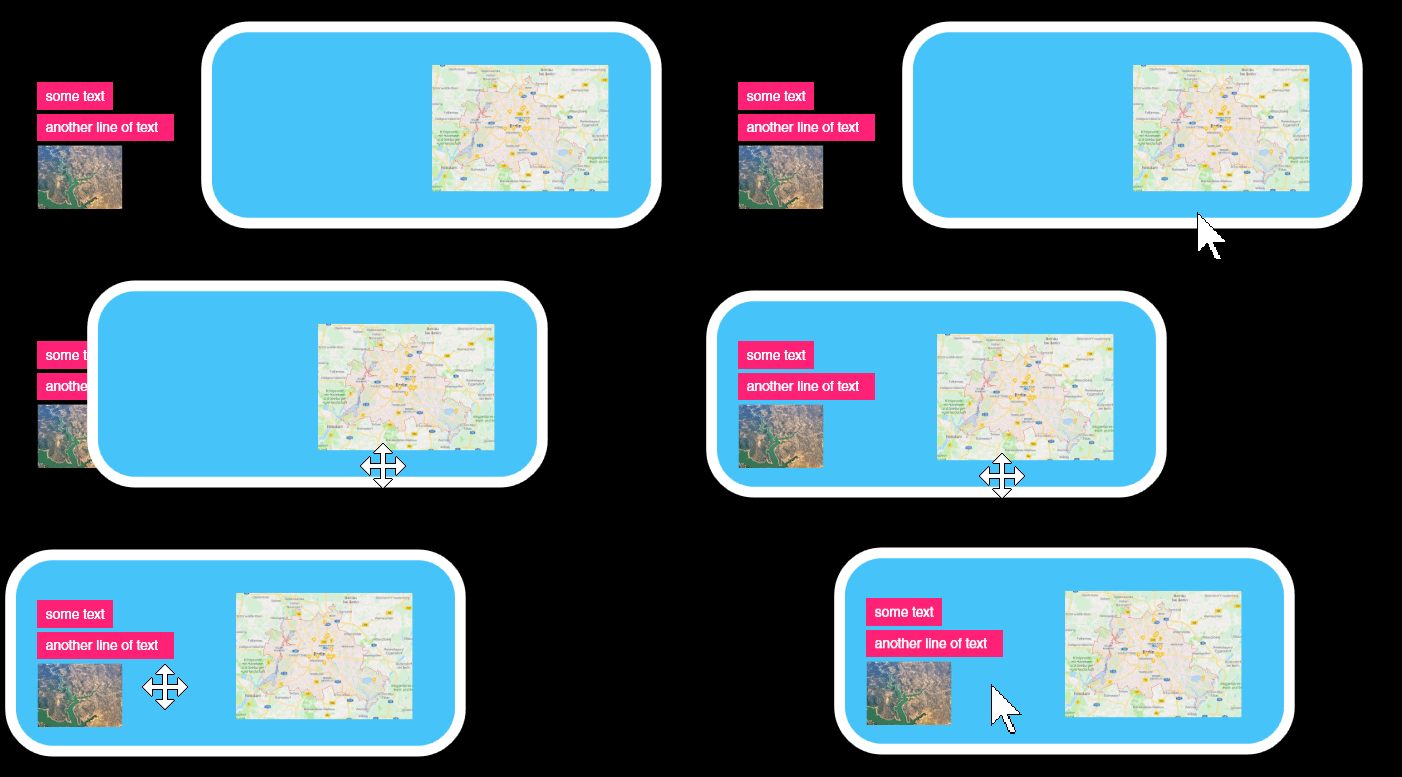
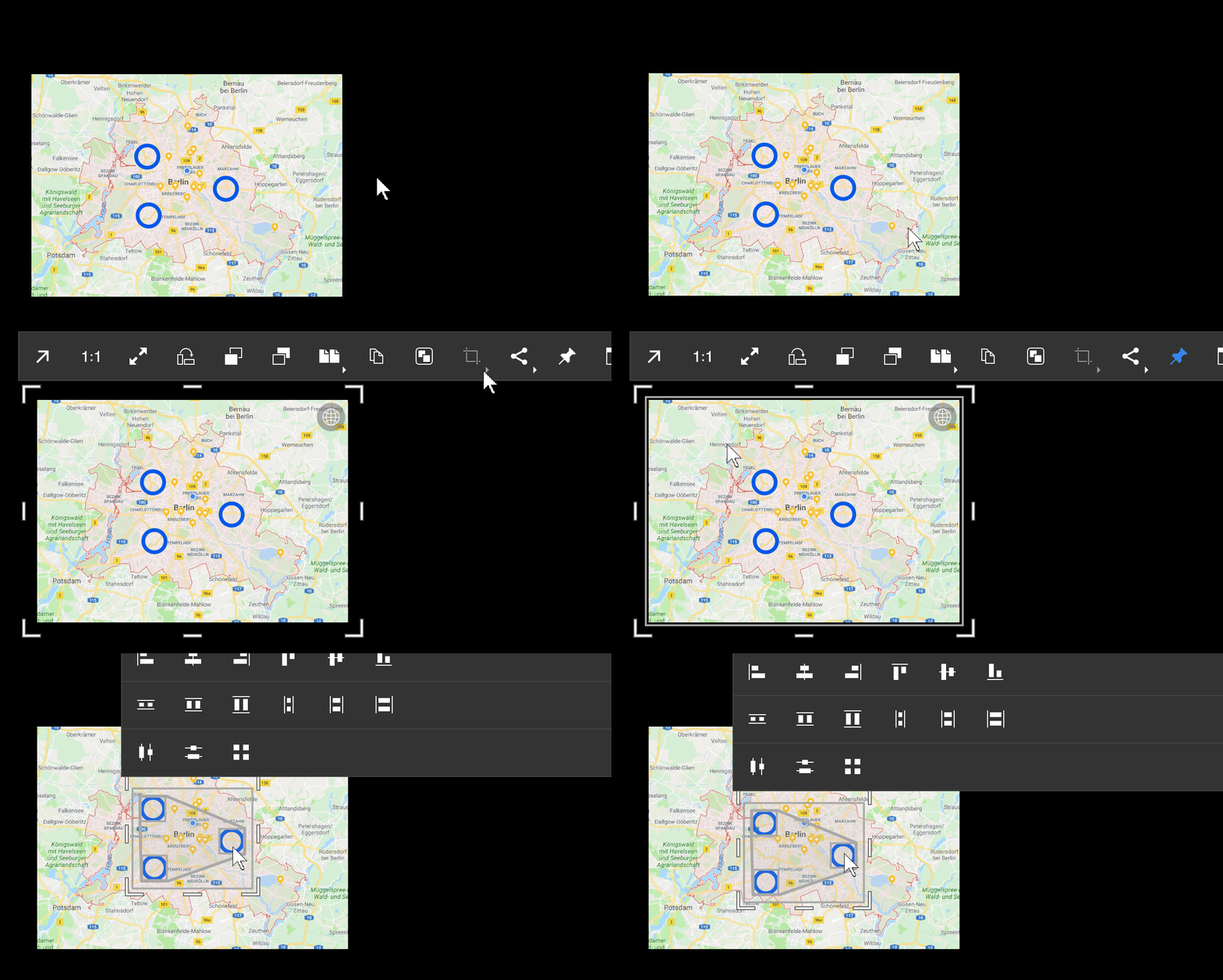
If you want to prevent this, simply pin the elements that should not rise with the  button in the context menu. Pinned elements are “stuck” to their background and only rise when this background rises (because a larger element covers it).
Pinning also prevents elements from being moved relative to their background. If you move a pinned element, its background will also move:
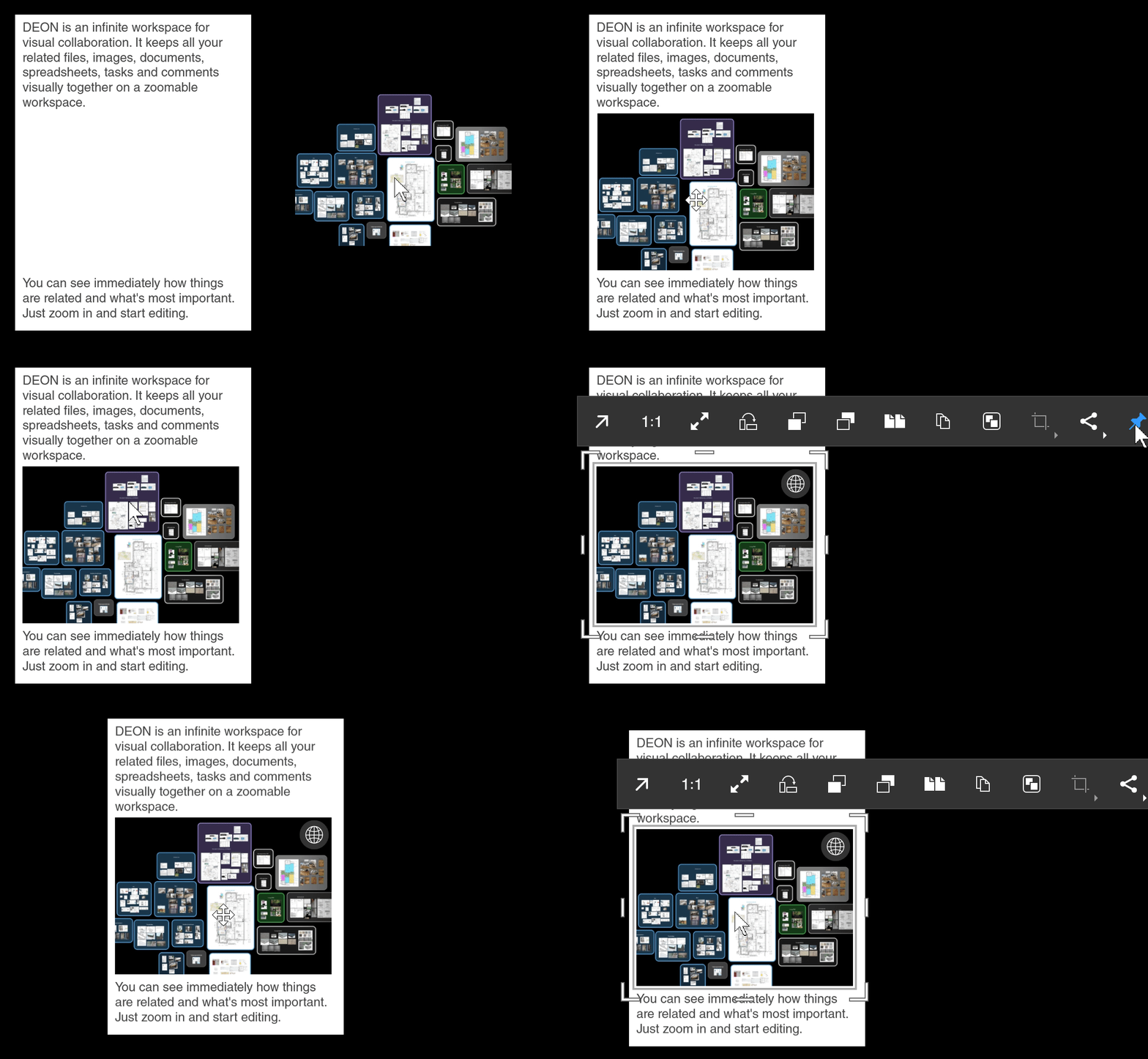
If you pin an element directly to the workspace, it cannot be moved at all until you release it again.
Pinning a background element also helps you to perform a multiple selection of elements on it:
Disable stacking and pinning mode
This mode can speed up complex layout situations. Pinning, stacking and rising are disabled by this button  . You can then move elements without affecting other stacked or pinned elements.
10 Crop and Resize
Use the  vertical and
  horizontal handles to resize or crop elements. Depending on the type of element, the effects are different:
Crop images and documents:
Moving the  or handles crops the image or document pages. This is particularly useful for large Excel spreadsheets.
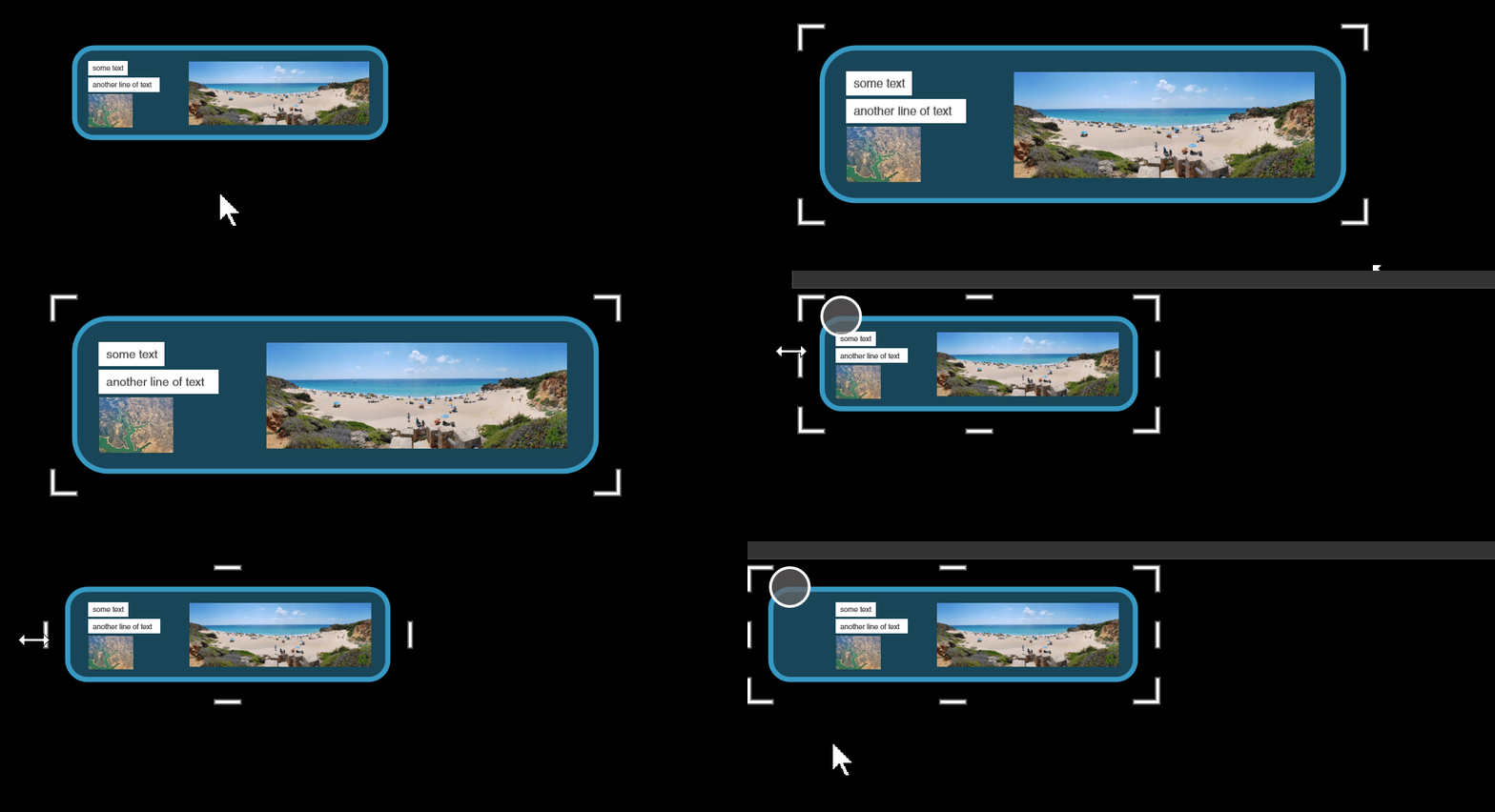
Change a line of text to a floating text box:
By moving the  or
or  handles you can change a text line into a floating text box with automatic wrapping. Locked handles appear blue. By double-clicking on a handle you can lock/unlock it. A red handle at the bottom indicates text overflow.
Trim/resize web browser:
By moving the and resize handles, you can create a web browser with very specific dimensions. This is useful if you want to see an entire scrollable website as a long image.
TIPMake sure not to make it too big. Unlike the  scaling handles, the
  resizing handles increase the resolution (and system load) of the browser when you enlarge the web browser. While with the
  scaling handles, the web browser resolution remains constant, only the representation in the workspace is scaled (just like when zooming the workspace itself).
Change shape size:
Moving the  and
and  resize handles changes the size of the shape, but keeps the corner radius, and elements on the shape retain their size. Elements on it are pushed in the resize direction when they reach the edge.
Scaling with the scaling handles scales the entire stack of elements as one unit.
11 Multi-page Documents
Bring the PowerPoint document that you previously dragged into your workspace to the center of the screen and press the ← → arrow keys to turn pages, or use a clicker.NOTE You don't need to select it first. If it's in the center of the screen, DEON automatically assumes you want to turn the pages.
Use the slider below to quickly scroll through large documents:
Select the document again and select the  Grid view button from the context menu to expand all pages.
To create a screenshot of a page: Click on the document (if not already selected) and then click the  Screenshot button in the bottom right corner of the page.
Now extract another page with the  extraction button in the same corner.
NOTE The screenshot is simply an image of the page, while the extracted page is still linked to the document and you can open the entire original document by pressing the  File button in the upper right corner of the individual extracted page.
TIPYou can easily merge multiple PowerPoint documents or extracted pages into a new document: Select the pages or documents you want to combine multiple times. Click on the  Merge button in the context menu.
TIP To compare a page (or another element in your workspace) with remote elements in your workspace: Select the element and choose  Anchor Element in the context menu. The window with the anchored view remains in front of your workspace while you navigate to another location.
Now zoom to a page and press the  Collapse button. DEON collapses the document, flips to this page and automatically centers the document on the screen:
Annotations on documents
Click on  in the main menu or press P to switch to scribble mode. Draw some annotations on different pages of your document. Also try the two different
  erasers from the scribble menu.
To exit the scribble mode, click on the  pointer mode button in the main menu or press V.
TIP If you have a touchscreen with an active stylus (like Microsoft Surface), DEON automatically switches between scribble mode and pointer mode for you, and you can use the back of your stylus to erase.
Create some arrows: Click on  in the main menu or press L. Select
  from the submenu. Start your arrow on a line of text and point it to a location in your document. Or drag the horizontal or vertical connector handles
 on the edges of an element to create connectors directly.
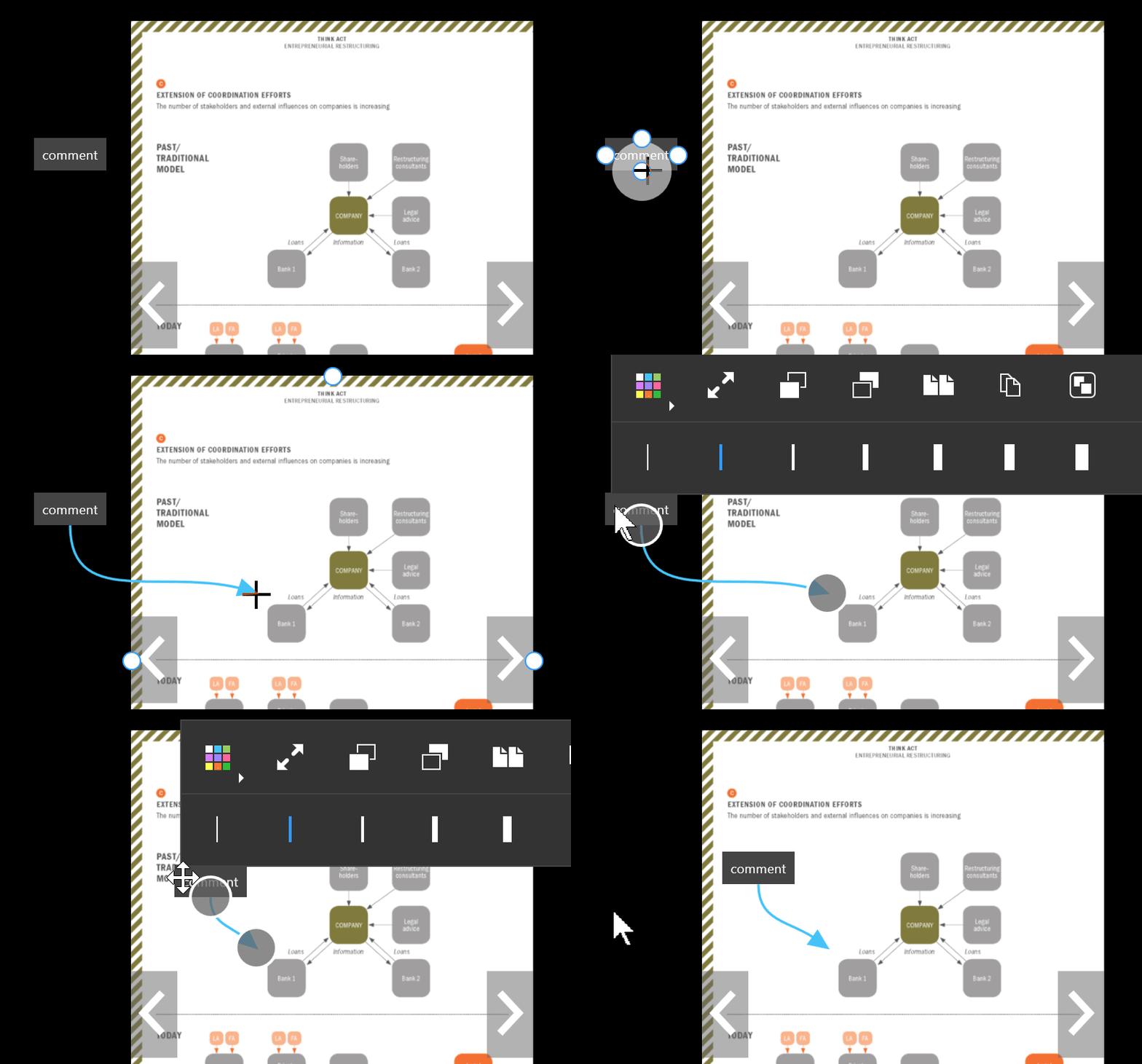
NOTE When you turn the pages of your document, all annotations remain on their respective page.
TIP To export the PowerPoint document together with the annotations on it: Click on a page, select  Share/Export in the context menu and select “Export … with annotations”.
12 Template Library
NOTE Any content you create in your projects can be used as a template if you store it in your library. Your library is available in each of your projects. You can also share templates with other users.
Select the elements or select them multiple times, which you want to save as a template. Click on  Share/Export and select
  .
.
Click on  in the main menu to open your library. To see how it works, you can now drag and drop your newly created template into your workspace.
Now select a single element in your workspace, click Share/Export again, but this time choose  .
.
Open your library (if not already open) and click on  in the top left corner. Enable/disable the checkboxes
  and
and  to see how the filter works.
NOTE The only difference between templates and symbols is the naming. It helps you categorize your library into two areas. You should simply use “templates” for everything that is not used like a symbol.
TIP “Template” and “Symbol” are predefined tags. You can create and reuse as many individual tags as you want: Right-click on a template (or symbol) in your library and select  . Enter your desired tag name and press
  . You will find your newly created tag in the list below, where you can also assign other existing tags.
TIP You can edit multiple library elements simultaneously by drawing a frame around them or selecting multiple elements with Ctrl or Shift.
Modify templates
NOTE A template is technically the same as a normal DEON project. You can open and edit it with the same flexibility:
Double-click on a template or a symbol in your library. It will open in a new DEON window. Make your changes and simply close the window when you're done. Changes are saved immediately as you make them (even before you close the window).
NOTE Although templates are technically DEON projects, they do not appear in your project list. You can only find them in your library.
TIP You can use SVG for icons. SVG is a vector format, and vectors do not become blurry when enlarged like pixels. DEON supports SVG via Drag & Drop, and you can also copy/paste vectors directly from ADOBE Illustrator. Scribbles, shapes, arrows, lines, and text created directly in DEON are also vectors.
Share Templates
Select one or more items in your library. Right-click on it and select  from the context menu.
The invitation window appears. Enter the email address of the user you want to share your project with and click on  . The entered email will appear in the field below, where you can adjust the rights for this user. Then click on
  .
.
NOTE If the entered email address does not yet have a DEON account, an invitation email with further instructions is automatically sent to this address.
The templates or symbols you have shared will be listed immediately in the library of other users.
TIP To share with multiple users simultaneously: Enter multiple email addresses separated by semicolons ; or line breaks, or copy/paste a list from Excel or any text file.
Back to top13 Presentation Paths
NOTE DEON allows you to switch between work and presentation immediately, without wasting time on exports and fiddly layouting.
Switch to presentation mode by clicking on  and then on
  in the main menu.
Now select the elements or select them multiple times that you want to present as the first step, and click the  Add Step button in the Presentation Path menu below your workspace.
Select other elements for your second step and press  again. Repeat this until you have five steps in your timeline.
Now select (click on) the first step in your timeline and press the  Present button on the far left or simply press F5.
DEON switches to full-screen mode and you can navigate through your presentation path using the arrow keys ←→ on your keyboard or your preferred remote clicker.
TIP You can continue to navigate in the workspace with your mouse, touchscreen or trackpad. Press k to fly back to the current step.
To exit full-screen mode, press Esc . To completely exit presentation path mode, press Esc . During full-screen mode, you can also use the on-screen buttons that appear when you click or touch the screen once.
TIP You can press F5 directly after opening a DEON project to start the first presentation path from the beginning.
TIP You can export your presentation path to a multi-page PowerPoint or PDF document: Press  to the left of your presentation path timeline and select
  .
.
TIP You can create automatic presentations by setting a timer for each step. If the last step has a timer >0, the presentation will be played in a loop.
Back to top14 Copying between Projects
NOTE Normally, you have multiple DEON projects open at the same time. This gives you the agility to switch between different topics immediately during the day. You can also easily copy and move elements between projects. For example, if you don't want to share an entire project, you can copy a part of it into a second project and share this excerpt instead. Try copying between projects now:
Leave your current project open and create a new project, as you did in Step 2.
TIP To switch quickly between multiple open projects, use the Windows key combination Win+Tab as a good alternative to Alt+Tab.
Select elements in your first project or select multiple. Press Ctrl+C to copy the elements, or Ctrl+X to cut them. Switch to your second (empty) project. Press Ctrl+V to paste the elements.
Back to top15 Share and Link
NOTE Sharing projects with other users is like sharing a desk or a room with them. Other users can open the shared project anytime, anywhere, and view or edit the elements in the workspace (if you have allowed it).
To share a project, click the "Share" button in the main menu  (
( in older versions) and select
  . If your project is still unnamed, you will be prompted to give it a name. Then the invitation window will appear. Enter the email address of the user with whom you want to share your project and click on . The entered email will appear in the field below, where you can adjust the rights for this user. Then click on .
NOTE If the entered email address does not yet have a DEON account, an invitation email with further instructions is automatically sent to this address.
TIPTo share with multiple users at once: Enter multiple email addresses separated by semicolons ; or line breaks, or copy/paste a list from Excel or any text file.
The project you have shared will be listed immediately in the project list of the other users.
To get an impression of how it works when two users have opened the same project, you can open a second instance of it on your own computer:
Double-click on the small  DEON taskbar icon. Remember that a single click opened the notification window. A double click now starts a new instance of DEON and calls up the DEON start screen, where you will find all your own projects and projects of other users that have been shared with you.
TIP Click the  List view /
  Grid view button in the top right corner of the start screen to switch between a thumbnail view or text view of your project list.
Double-click on your project (which is currently still open in the second instance of DEON) to open it. You now have two DEON windows with the same DEON project.
Try navigating and editing your project in both instances. Note that each instance can display a completely different part of the same project, but changes are synchronized immediately. This experiment demonstrates how other users would experience your shared project.
TIPIf you want other users to follow you and see the same part of the project (e.g. during a phone conference), press the  Connected View button in the main menu. Read more about this powerful feature here.
TIPYou can share a link to any element or multiple selection in a project: Select elements in your workspace or select them multiple times. Click on  Share/Export in the context menu and select
  . You can now paste this link into any email or chat program (Ctrl+V) and send it to other users. When the recipient clicks on the link, DEON will automatically load the project and navigate to the linked elements. Remember that it must be a shared project, otherwise access will be denied.
TIP If you have Microsoft Teams installed, sharing links during a chat is even faster. Click Share/Export in the context menu and select  . DEON automatically copies the link to your currently active chat input field.
NOTE When sharing projects, keep in mind that linked documents in your project can only be seen by users who have access to the original file location (e.g., a network share); otherwise, they will only see a gray placeholder.
Creating shortcut buttons in the workspace
You can turn images or screenshots into clickable buttons. The target link URL can be:
- Any external URL like https://deon.de
- Any file path to a file or folder like D:myfolder or D:myfolderimage.jpg
- Any element or selection in the current project or in another DEON project:
Select multiple elements in any DEON workspace, click on Share/Export and select . - Any DEON project: Right-click on a project in the start screen and select 'Copy Link'.
- Copy any target link URL to your clipboard.
- Select any image or screenshot in any DEON workspace and click the Edit Link button in the context menu
 .
. - Paste the previously copied link into the field. You can now choose whether the entire image should serve as a button. Otherwise, a small button appears in the top right corner of the image.
NOTE To select a button that is fully clickable, you must draw a
selection frame around it. TIP Check out the Jira and Azure DevOps integration to add and link issues.
16 Export
NOTE If your workflow allows it, try to stay in DEON instead of exporting. You can use the sharing features to exchange information and the presentation path to hold presentations. You could also temporarily copy elements into another DEON project if you don't want to share an entire project, and later copy things back. If you stay in DEON, you remain more flexible and interactive and avoid redundant data. However, there are situations where export is essential, and the following powerful export features are handy:
Exporting some elements or the entire project
Select some elements in your workspace or select them multiple times. Click on “Share/Export” in the context menu and select PDF or PowerPoint as the export format. To export the entire project, simply drag the selection frame over all elements. You can also save the selected elements in their original format by choosing “Save As…”. If you have selected multiple elements, a ZIP file will be created.
Export to a multi-page document
Use the 'Export with Annotations' feature of a PowerPoint document or use the export feature of a presentation path or use the slide function. With the slide function, you can place multiple slides in your workspace. These slides can later be exported to a multi-page PowerPoint after you have created text, images, doodles, and shapes on them. To customize the background of these slides (e.g., with your company branding), you can import POTX files. You can easily create your own POTX files by saving a PowerPoint as POTX instead of PPTX.
To create slides in your workspace, click on the  Widgets button in the main menu, then on the
  New Presentation Slide button, and click anywhere in the workspace. Select a template and layout and click on
  .
.
To create more identical slides, hold down Ctrl and drag a slide (or multiple multi-selected slides).
NOTE Slides cannot be scaled. This helps you maintain a constant aspect ratio between multiple pages.
Now create content on the slides or drag and scale existing content onto them.
Select all slides multiple times, click on  Share/Export in the context menu, select
  and click on
  . The order of the slides in the exported PowerPoint is defined by their position in the workspace (from left to right or from top to bottom).
17 Versioning
NOTEDEON is a command-based system. This means that every single action, such as a stroke or moving an element, is immediately saved as a command, and a DEON project is the result of a sequence of commands. This principle allows you to restore a copy of a project at any stage of its creation at any time. One reason might be to look into the past or restore a project that was accidentally messed up by a user.
Switch to the start screen by clicking on  in the top left corner of an open project or double-clicking the small
  DEON taskbar icon. Right-click on a project and select
  from the context menu. Now navigate through the history list by clicking on the
  buttons to go all the way down a tree to a desired revision number. Then click on
  . Wait while the copy of the project is created. You may be asked if you want to share this copy with the same users who already had access to the original project. After that, the restored project will appear in your project list.